skip to main |
skip to sidebar
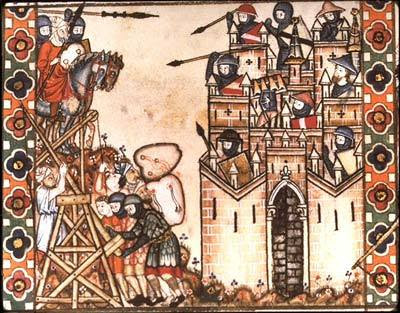 The history of the Middle Ages is fascinating, especially where wars and fighting are involved. The iTunesU collection that Jeff and I created is called "Medieval History and Crusades" and contains podcasts relating to both Medieval history and some specifically about the Crusades. The story of the many Crusades is complex, involving political, social, military, and religious histories. Due to the length of the podcasts, I would select excerpts from one or two to provide my students with background knowledge on the Crusades.
Without supplementation, though, listening to podcasts is hardly different from sitting in class while a teacher lectures. I found a worksheet that would be a good way to introduce students to a variety of primary sources from this era and get them thinking about the issues driving the Crusades. I would then present the students with several more primary sources, such as those from Eyewitness to History, The Avalon Project, and Primary Sources on the Crusades. To help students visualize the situation in Europe and the Middle East I would supply students with maps that note important aspects of the conflict. In small groups students would analyze the various sources, then answer guiding questions to synthesize the information and draw conclusions about the conflict driving the Crusades.
After this work with primary documents, I would present students with more recent sources, such as news articles, videos, or podcasts that address current or recent issues in the Middle East. This does not provide a full time line of Middle Eastern history, but it will help students relate past conflicts to current events. Like before, the students will work in small groups to analyze each source to determine the causes of current Middle Eastern conflicts.
After listening to podcasts, completing the worksheet, reading through primary source documents, examining maps, and investigating current events, students will be equipped to analyze the causes, goals, and strategies of the opposing parties in the Crusades, and the outcomes of their efforts. Individually, the students would consider and discuss whose side in the Crusades they would have supported. I would ask them to describe the lasting impact of the Crusades, given the intense conflicts that still threaten the "Holy Land" today. Some of the sources used in the lesson are podcasts, videos, and newspaper articles, so I would let the students choose to present their response in any of those formats. This gives them the opportunity to synthesize all of the different sources and their small group discussions into their own creatively expressed but well-supported opinion.
The combination of these easily found, online resources facilitates meaningful learning for students as they examine primary material and make connections between history and current issues.
Non-Podcast Resources for this Lesson:
-Maps of the Crusades
http://www.emersonkent.com/wars_and_battles_in_history/history_of_the_crusades.htm
-Worksheet- "Two Sides in a Crusade"
http://www.eduplace.com/ss/hmss/7/unit/act5.1blm.html
-"Eyewitness To History"
http://www.eyewitnesstohistory.com/crusades.htm
http://www.eyewitnesstohistory.com/lionheart.htm
http://www.eyewitnesstohistory.com/crusade1250.htm
-"The Avalon Project"
http://avalon.law.yale.edu/medieval/richard.asp
-"Primary Sources on the Crusades"
http://www.deremilitari.org/resources/categories/crusades1.htm
Find and share an example of a social studies blog, podcast, and wiki not identified in the reading. If possible, find examples actually created by students. Explain why you chose those examples and how they support meaningful learning.This week's search for blogs, podcasts, and wikis was both interesting and challenging. Many teachers utilize these technologies for their classes, but it took me a long time to find authentic student work. After much searching I successfully found examples of students using technology to enhance their educational experiences.I hit the jackpot and found a school that had archived some of its social networking resources, including notable student blogs. (Click here to see this page.) The blog I have decided to share is from a student named Ashley. As I perused her various posts I was very impressed. She created the blog for her social studies class and many of her posts were social studies related. However, she also posted about a lot of non-social studies topics, which revealed things about her interests and personality. It is very clear that Ashley was engaged in meaningful learning through her blogging project. However, I think that the most valuable things she learned had nothing to do with actual social studies content. I took the following quote from one of Ashley's posts: “Since blogging, I have felt more comfortable talking in front of people and speaking clearly. It now makes talking to my small class easier because I know that I’ve talked to alot more people world-wide! I also developed a better vocabulary and I can spea[k] more fluently without saying “um” or “like” as often as I used to.” Wow. I never even considered that blogging would affect a person's public speaking abilities. Ashley was learning about more than social studies while she interacted with other student bloggers. Visit Ashley's blog to see what her experience was like.I found some cool podcasts from Mr. Brewer's APHG classes at Brunswick High School. Small groups of students shared information on various supranational organizations, like OPEC and NAFTA. Some of the groups made their podcasts in a conversational style, which was informative, but more entertaining than a straight forward report. These students not only needed to learn about their specific organization, but had to know what makes an audio report interesting and informative to the audience outside their classroom (people like me!). By making a podcast they were taking ownership of the social studies content. Because they shared their work with a world wide audience, I think this was a more meaningful learning experiencing than just giving a report in front of the class.Wiki pages have nearly endless potential for classroom application. The wiki I would like to share was created by "Enhanced Learning students," aged 10-12. They did a class research project on pirates and presented it as a wiki, found here. Each student was responsible for researching a specific topic and they were all combined to create the final product. A similar project would be also be appropriate for middle and high school students. Within any given social studies unit or theme, teachers could have students create wikis to present their work. This is not only for the benefit of the students, but allows others to access their research, as well. Imagine being a student and knowing that people from around the world might read your research to learn more about a given topic! Even after the student completes that course, they can still look back at what they did and be proud of it. I can't think of many more ways to make learning more meaningful than that.In my searching through blogs, podcasts, and wikis for this week's post I was very impressed with the quality of the student work I found. I couldn't believe that the blogs I read were written by 14 year old students. Maybe using technology in the classroom encourages a greater sense of maturity as students demonstrate their learning via a more sophisticated medium than paper reports. If they can do it, I can do it, too!


